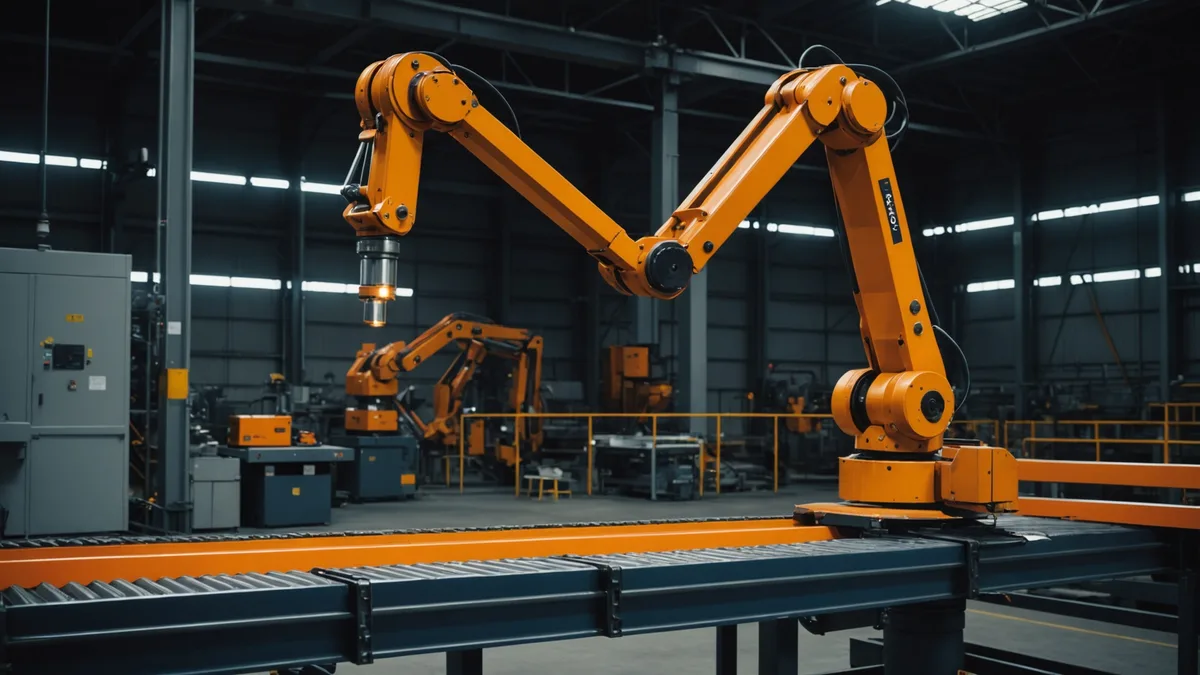
Most robot ROI analyses classify initial programming as a capital cost: reserve integration time, pay the integrator, and begin production. That model assumes programming cost has a limit. It occurs once, then ends.
That works for lines producing one product type indefinitely. It does not work for everything else.
In flexible manufacturing, robots are reprogrammed regularly. A product variant change can require it. So can a new fixture design or different bin configuration. A supplier swap that alters part tolerances by half a millimeter can do the same. Each event begins the same sequence: integrator contact, scheduling, site visit, path reprogramming, test cycles, and sign-off. At most facilities, that sequence takes two to three weeks per task change and cannot run in parallel with production.
What a Reprogramming Cycle Actually Looks Like
A plant floor manager familiar with this process knows the sequence by feel. The integrator gets contacted at the end of the week. The earliest visit is ten to fourteen days away. After arriving, the integrator reviews the new fixture and spends one to two days rewriting path programs on the teach pendant. Testing follows: the robot runs the new path, fails on edge-case orientations, gets adjusted, and runs again. If testing exposes a fixture tolerance issue, another iteration follows. After successful test runs, sign-off takes another day.
From identifying the problem to restarting production, one reprogramming event usually costs three to four weeks on the calendar. The integrator's direct bill may account for only 20 to 30 percent of the actual cost. The remainder comes from floor downtime, delayed delivery, and rescheduling production on other lines.
That calculation becomes much harder to justify when it occurs four, six, or eight times per year.
Variant Count Multiplies the Problem
The manufacturers facing this most sharply are not running one or two variants. Over a quarter, they run ten, twenty, or thirty SKUs on the same physical line. Examples include consumer electronics sub-assemblies, automotive connector brackets, packaged food containers, and metal brackets for appliance housings. These are not niche operations. They make up a large and growing share of mid-size contract manufacturers.
For these plants, reprogramming is a regular operating cost, not an exception. The automation manager knows which robots need reprogramming and which products are waiting behind them. Integration lead time, rather than production demand, shapes the schedule.
This is structural rather than logistical. Traditional robot programming ties a particular task to a particular code artifact. Change the task, and the code must change as well. Integrators are not bottlenecks because they work slowly. They are bottlenecks because the programming model calls for expert intervention whenever a change occurs.
The Downtime Cost That Gets Misattributed
Part of the reprogramming cost appears in maintenance budgets. Integrator invoices are easy to see. Downtime is more diffuse, and it often is not assigned to the robot system.
When a robot is locked out of a line for reprogramming, that section usually cannot run. Some plants can use alternative routing, but doing so requires floor rebalancing and its own coordination cost. In practice, many plants absorb the downtime and delay the affected production order. The cost appears in on-time delivery performance rather than robot maintenance costs.
When we speak with operations teams at manufacturing facilities running variable production, we consistently hear the same framing: "we planned for robot upkeep, but we did not plan for the job-switch overhead." That overhead is real, recurring, and increases with variant count.
When the Math Stops Working
There is a rough point at which the reprogramming model stops making economic sense. For a robot running one high-volume product line, setup amortization is essentially irrelevant. For a robot switching tasks quarterly, automation still wins on the math. For a robot switching monthly or more often, the payback calculation begins to invert, depending on integrator rates and downtime cost assumptions.
The issue is not that robot hardware cannot serve variable production. The issue is that its programming interface assumes a task-stable environment. When the operating environment varies by task, the interface becomes the bottleneck.
A Different Starting Point
That is the specific problem Robai was started to address. The insight is not that robots need greater speed or precision. The process for telling a robot what to do needs to work differently when tasks change frequently.
Demonstration-based learning reduces the reprogramming loop from weeks to hours. The person who understands the task can transfer that knowledge directly to the robot without writing code. A technician guides the robot arm through the target motion, the system builds a deployable policy from those demonstrations, and production starts the same day.
This does not solve every scheduling problem in manufacturing. It does not remove changeovers or make fixture design irrelevant. For plants where job-switch overhead is eroding automation economics, however, it addresses the root cause. The constraint is not the robot. It is the reprogramming process, and that process can be redesigned.
If your facility has more than eight task changes per year across its robot cells, the reprogramming loop deserves a line item in the true cost model. Most ROI spreadsheets lack one. Adding it changes what the numbers show.