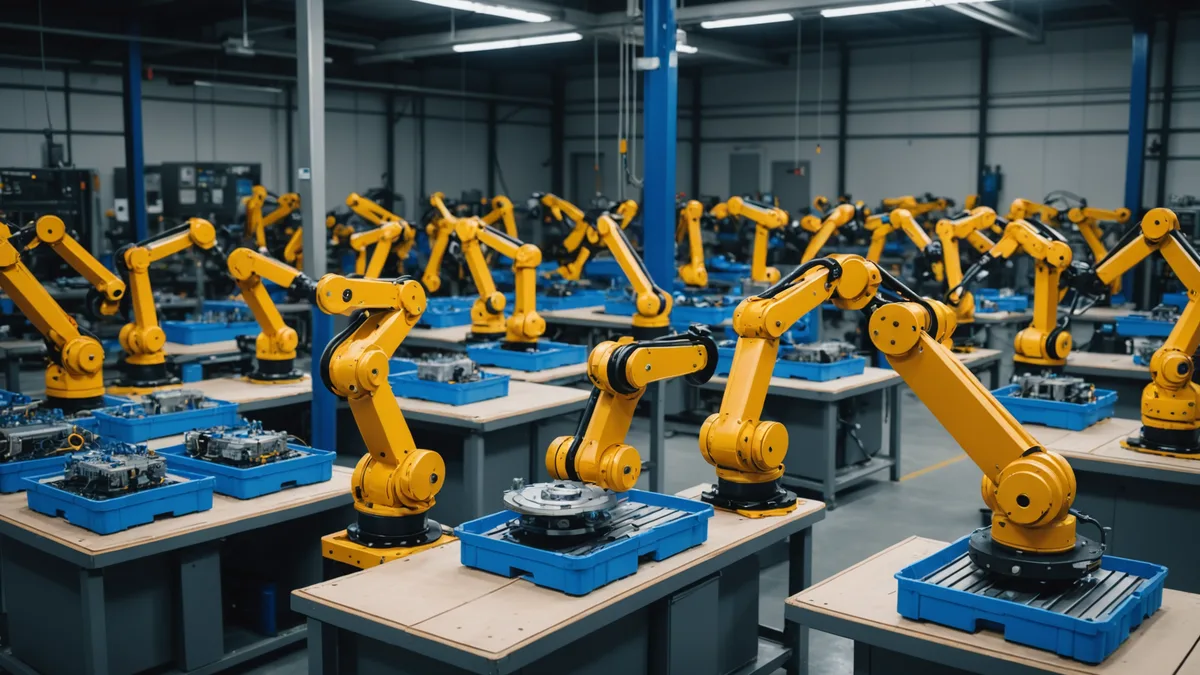
Robot deployment economics assumed high-volume production. Capital costs were justified across multi-year runs of one part, with enough units to make per-unit amortization negligible. That approach fit manufacturers planning three-year runs for individual products.
Small and mid-size manufacturers now operate in a different environment. Customer orders have fragmented. In 2015, a mid-size contract manufacturer might have produced three to five part families monthly. Today, that facility may handle fifteen or more. Batches are smaller, delivery expectations are faster, and lower quantities are common. A line once dedicated to one part for six months may now change part types every week or two.
Robot deployment assumptions from the old environment no longer apply.
What Small-Batch Means for Automation Economics
People often describe small-batch manufacturing as high-volume manufacturing with fewer units. Its automation challenge is different in kind, not merely smaller in scale.
For high-volume manufacturing, the central measure is unit cost at steady-state throughput. The robot pays for itself by making one part repeatedly, with strong repeatability and little downtime. Reliability and throughput optimization are the main concerns.
Small-batch production may end before steady state is reached because the line must switch to another part. At a 30-second cycle time, 200 units require less than two hours of production. If setup and changeover take eight hours, run-time represents only a minority of the time that batch occupies the line. The useful measure is productive run-time compared with setup time, not steady-state throughput.
In this setting, the setup time ratio can be punishing for robots. Traditional programming spreads a multi-week setup cost across a run too short to absorb it.
Where the Demand Shift Came From
Several structural forces are moving manufacturing toward smaller batches.
Supply chain risk management has prompted buyers to spread orders among multiple suppliers instead of concentrating volume. Each supplier receives smaller orders, while more SKUs are managed through more supplier relationships.
Product lifecycle compression has reduced the time between design revisions. This is especially true for electronics and consumer goods sub-assemblies, where new variants replace earlier products before production tooling is fully amortized. Manufacturers now tool products expected to run for eighteen months rather than four years.
Custom and configure-to-order manufacturing has expanded as a competitive differentiator in industrial equipment, specialty packaging, and medical device subassembly. Each custom configuration effectively forms a batch of one to ten units. Automation built for mass production does not serve this segment.
The Cobot Promise and Its Limits
Collaborative robots were promoted for small-batch and flexible manufacturing. The pitch emphasized lighter, cheaper, safer, and easier-to-program machines. Replace traditional industrial robots with cobots, the argument went, and the flexibility problem disappears.
The cobot market met some of those expectations. Cobots are genuinely safer around workers, enabling deployment scenarios that traditional robots would require fencing off. Their prices have also fallen to a level where smaller facilities can access the capital cost.
The belief that cobots would be much easier to program than industrial robots has held up less well. Simple tasks are more approachable, but anything beyond basic pick-and-place still calls for integrators or programming specialists. When a cobot must handle a new part variant, the loop remains: call the integrator, schedule a visit, wait, reprogram, and test. The hardware is flexible, but the programming workflow is not.
This is not a criticism of cobot manufacturers. They produced hardware better suited to flexible deployment. Yet the programming interface still follows the underlying model used by traditional robot programming, where a human expert writes explicit motion instructions. Changing the hardware does not change that model.
What Flexible Lines Need from Automation
Variable small-batch lines need automation suited to requirements different from those of the dominant production model.
The robot must change tasks according to the production schedule, rather than integrator availability. If a task change is needed Tuesday afternoon, it must occur then. A three-week integrator lead time cannot support that schedule.
Task changes should be configured by someone present on the floor who understands production context. Usually, that means a line technician or automation-aware operator, not a visiting specialist. The knowledge needed to configure the robot should correspond to what that person already knows about the task.
For small-batch economics to work, task switching overhead must be counted in hours rather than weeks. A full-shift changeover can be absorbed when it enables a week of production. A three-week changeover removes the economic case for automating short-run parts altogether.
A Deployment Model for This Environment
Demonstration-based learning addresses the gap between conventional robot programming and variable production. The person who understands the task can configure it without programming expertise, and configuration time is counted in hours, the same unit used for the production run, rather than weeks.
Demonstration learning is not the right answer for every manufacturing context. On stable high-volume lines, programming overhead can be comfortably amortized across long runs. Traditional scripted programming works well there, with its overhead justified by the precision and reliability it provides.
For small-batch manufacturers, the key question is how often that overhead fails to amortize. If the answer is "most batches," the conventional method has a structural problem. Robot technology exists for the new operating environment. The economic case for deployment depends on measuring changeover costs honestly and comparing them with the alternatives.