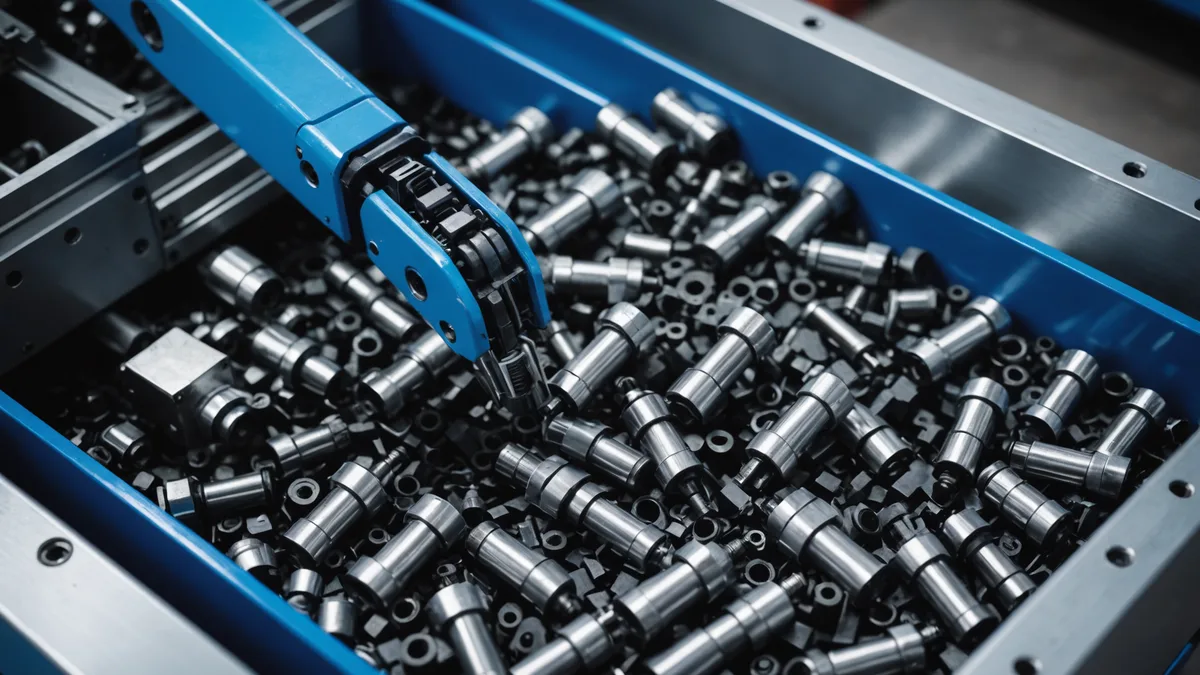
Bin picking remains one of industrial robotics' oldest unsolved problems. The task sounds basic: take a part from a bin and put it in a specified location. In practice, "a part from a bin" may appear in any of hundreds of orientations, be hidden by other parts, sit under changing light, or have a surface finish that confuses vision systems.
Generalization means a robot system can handle variation beyond the conditions used for training. That ability is the key technical requirement for practical bin picking. A robot limited to parts shown in one orientation is not addressing bin picking itself. It is handling a far simpler constrained task with the same hardware setup.
The Orientation Problem
Take a machined metal bracket. In a bin, it may settle in several stable positions: face up, face down, or on either edge. Each position calls for a different gripper approach angle to achieve a dependable grasp. Required gripping force changes as well, as does the wrist rotation needed to present the part correctly to the next stage.
A system trained only on face-up positions has learned to map that particular visual state to one grasp action. A face-down part falls outside its training distribution. Responding correctly requires recognizing that unfamiliar condition, reasoning about the part's 3D geometry, and inferring a grasp strategy for the new orientation.
That means the system needs a model of the part's geometry and its relationship to grasp quality. Such a model may come from training across diverse orientations, explicit 3D part models registered to the observed point cloud, or both. Creating adequate models for every part type handled by a flexible manufacturer demands significant upfront investment, reducing the speed advantage of deployment.
Surface Properties and Sensor Failures
Machine vision for detecting grasp points uses depth sensors, usually time-of-flight or structured light, together with RGB cameras. Both respond to surface properties in predictable ways once understood, yet those effects can be frustrating in production.
Very reflective metal, including polished stainless steel and chrome-plated parts, can make time-of-flight sensors return incorrect or missing depth readings. The signal is specular instead of diffuse, so the sensor reads geometry that differs from the actual surface. This creates holes or systematic errors in the depth map, often precisely where grasp points need to be selected.
Matte black surfaces create the reverse issue. They absorb too much structured light or IR pulse, yielding weak return signals that the depth sensor reads as no-return. Holes then appear in the depth map again. Black rubber gaskets, coated plastic housings, and anodized aluminum parts belong to this group.
RGB-only grasp detection avoids depth sensor problems, but it must infer 3D geometry from 2D images. When parts have uniform color and no distinctive surface markings, pose estimates become ambiguous and can fail when the inferred geometry is incorrect.
These issues can be solved, but they need explicit treatment: sensor fusion, surface-aware preprocessing, and fallback logic when primary detection fails. A system that handles shiny parts on its spec sheet but fails on matte-black parts in production is not deployed. It remains a prototype.
Pile State and Occlusion
Parts in a production bin change arrangement throughout a shift. As the bin empties, the pile geometry changes. Parts near the bottom may rest against the bin wall in physically possible orientations that appeared rarely or not at all in training data. Other parts may partially hide them in configurations the system has never seen.
Dependable bin picking must address partial occlusion directly. If only 40 percent of a part's surface is visible, can the system identify its type and estimate its pose well enough to produce a reliable grasp? For simple symmetric parts, partial occlusion is manageable with a good 3D model. For asymmetric parts whose functional features determine grasp strategy, hiding those features materially reduces performance.
In production, failure rate therefore changes during a shift. A freshly loaded bin, with parts spread in accessible orientations, has a lower failure rate than a nearly empty bin whose remaining parts are awkwardly positioned. Average grasp success rates without a stated bin state distribution describe a number that will not be reproducible in production.
What Generalization Actually Requires
Handling new part orientations and pile states requires some combination of three elements.
First is broad training coverage: demonstrations or generated data representing the actual state distribution the system will encounter. With many part types, bin picking may require hundreds or thousands of training examples per part type. The main cost is the overhead of collecting that data.
Second is dependable 3D part modeling: explicit geometric representations that let the system reason about pose from partial observations. Models may be created from CAD, scanned from physical parts, or learned from enough observation data. Every method requires time and effort.
Third is principled fallback behavior. When detection confidence drops below a useful threshold, the system needs predefined responses: retry from another approach angle, request human assistance, skip and flag the part, or stop and alert. Without fallback, a system cannot be deployed in real production because low-confidence situations will occur.
What We Have Found Practical
Experience with early-access partners in production environments suggests a pragmatic middle ground. For the part families partners actually run, covering the realistic orientation distribution with 30 to 50 demonstration sessions per task type produces systems that handle routine production variation. Tail cases, such as unusual orientations caused by rare bin loading patterns, use conservative fallback: the system declines a low-confidence grasp and requests re-presentation instead of attempting one likely to fail.
This does not fully solve bin picking generalization. It addresses a bounded version sufficient for the specific part types and bin geometries the partner runs. We make no broader claim. The boundary is important: demonstrating a new part type requires a dedicated demonstration session, rather than zero-shot generalization from the existing task library.
Knowing where that boundary lies is essential for setting accurate expectations before deployment. Exaggerating generalization capability and finding its limits in production is worse than setting accurate expectations and designing the workflow around them.