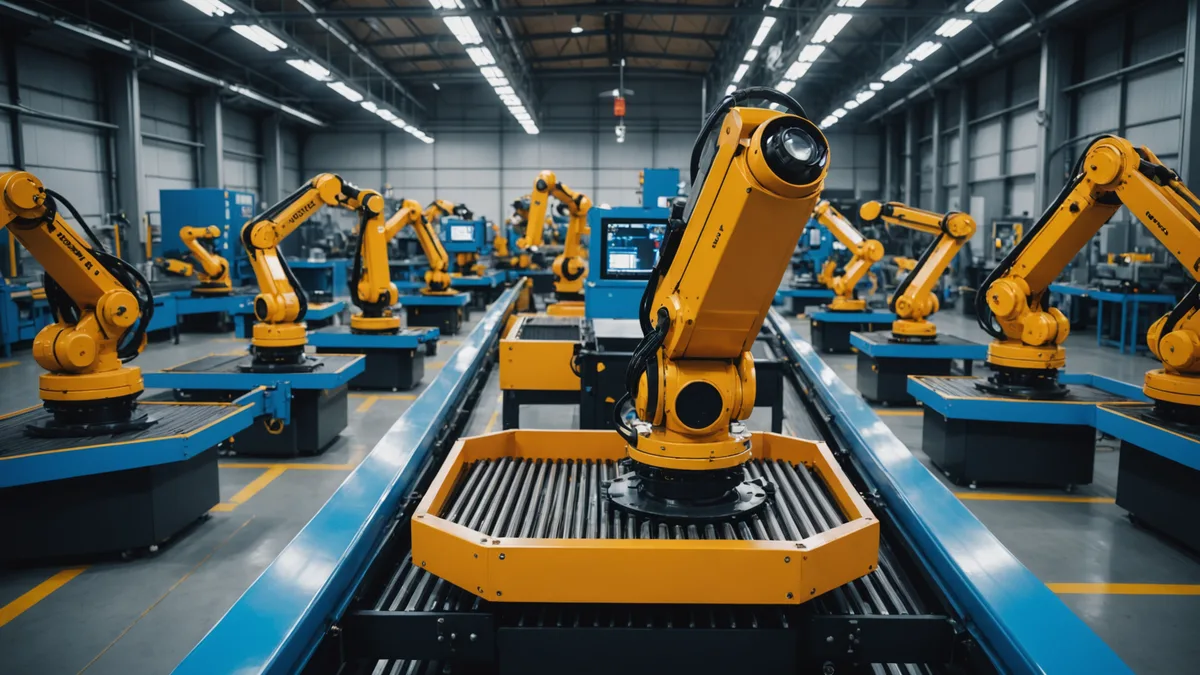
Industry coverage of manufacturing AI centers on two categories: predictive maintenance and quality inspection. Both deliver real value. Vibration sensors connected to anomaly-detection models can identify bearing wear before it leads to unplanned downtime. Computer vision systems on inspection lines spot cosmetic defects at speeds no human inspector can maintain. The technology works, and deployments are live in production plants.
These categories have something in common: both are observational AI. They monitor the line and flag signals, but they do not move anything. The more difficult problem, and the one with greater cost impact for most manufacturers we speak with, is physical AI: getting robots to perform tasks in changing environments.
Why Predictive Maintenance Succeeds
Machine learning suits predictive maintenance because its input-output relationship is well structured. Sensors generate time-series data, and failure modes leave signatures. The training task is to use historical vibration and temperature profiles to predict the next maintenance interval. That is a supervised classification problem involving structured data, exactly the kind current ML tooling handles well.
Deployment friction is low as well. Sensors attach to existing equipment, while data moves to a cloud historian or on-premise server. The ML model sends alerts to an existing SCADA or MES dashboard. There is no mechanical integration, robot arm, or end-of-arm tooling. The system operates beside the production line without interrupting it.
Quality inspection cameras follow a similar pattern. Vision systems sit above a conveyor or inspection station. Image classification models identify parts that differ from reference images. An operator reviews the flagged parts and decides their disposition. The AI advises rather than actuates.
Why Physical Robot AI Is Hard
Physical AI, meaning a robot that perceives and acts, must handle problems that observational AI avoids. It must localize parts precisely enough to grasp them and execute trajectories that account for mechanical compliance, part weight, and friction. If a part reaches the robot in an orientation slightly different from what was expected, the robot must choose whether to adapt its motion or stop and request intervention.
Its failures matter more than a false alarm from predictive maintenance. A false vibration-sensor positive sends a maintenance team to open a machine and find no problem. That is frustrating but recoverable. A robot that misreads a part's position during a grasp may drop parts, damage fixtures, or halt the entire line. Reliable operation therefore carries higher stakes.
This helps explain why physical robot AI has reached production floors more slowly than observational AI. The shortfall is not in foundational ML research, but in the integration path. Observational systems offer a clean integration story. Physical robot systems must address every layer: mechanical setup, controller integration, perception calibration, motion policy tuning, and failure recovery logic.
Where AI Helps Most With Physical Tasks
For physical tasks, AI is beginning to close the gap mainly in task setup time, not peak throughput. Traditional robot programming creates high-performance motion programs for fixed tasks. After a cobot or industrial arm is configured for a particular fixture and part geometry, it can perform that task with high reliability and speed. The difficulty is that configuration takes days to weeks.
Learning from demonstration can shorten that configuration window. Rather than writing motion programs, a technician shows the robot how to perform the task. The system extracts a policy from the demonstration, then the robot executes it. When the task changes, the technician demonstrates again and the policy updates. Reconfiguration time falls from days to hours.
This matters most to manufacturers with high product mix. The key measure is not peak cycle time, which traditional scripted robots handle well on stable tasks. It is time-to-task-change, which determines how much of the production calendar robot downtime consumes during changeovers.
Where Current AI Still Falls Short
Current physical robot AI still has clear limits. Sub-millimeter precision work, such as inserting a connector pin with a 0.2mm tolerance, remains at the edge of what demonstration-based learning can reliably achieve in production. Policy generalization is sufficient for pick-and-place and assembly tasks with reasonable tolerances, but tight-tolerance work still calls for conventional scripted programming or human operators.
Long, multi-step assembly sequences are challenging too. A task containing fifteen sequential steps offers fifteen chances for cumulative error. Demonstration-based policies expected to complete that sequence with production-level reliability need more demonstrations and validation than shorter tasks. This area is improving, not subject to a fundamental ceiling, but it remains a real constraint for the current generation of systems.
What to Prioritize
Manufacturers deciding which manufacturing AI investments make sense now can use a practical test: does the technology reduce a cost that is already identifiable and significant in my operation? Predictive maintenance pays off when unplanned downtime is expensive and bearing failures recur. Quality inspection AI pays off when inspection creates a labor bottleneck or defect escape rates are unacceptably high.
Robot task adaptation AI pays off when changeover time constrains scheduling, integrator visits recur as a budget item, or the plant runs more product variants than the robot can be programmed for in advance. Those three conditions describe a large share of the contract manufacturing and small-batch production market in Korea and across manufacturing regions in Asia.
Observational AI is the more mature category and carries lower deployment risk. Physical robot AI is earlier, but it addresses a larger problem that existing tools serve less effectively. For manufacturers with variable production lines, getting physical robot task adaptation right is the stronger priority.