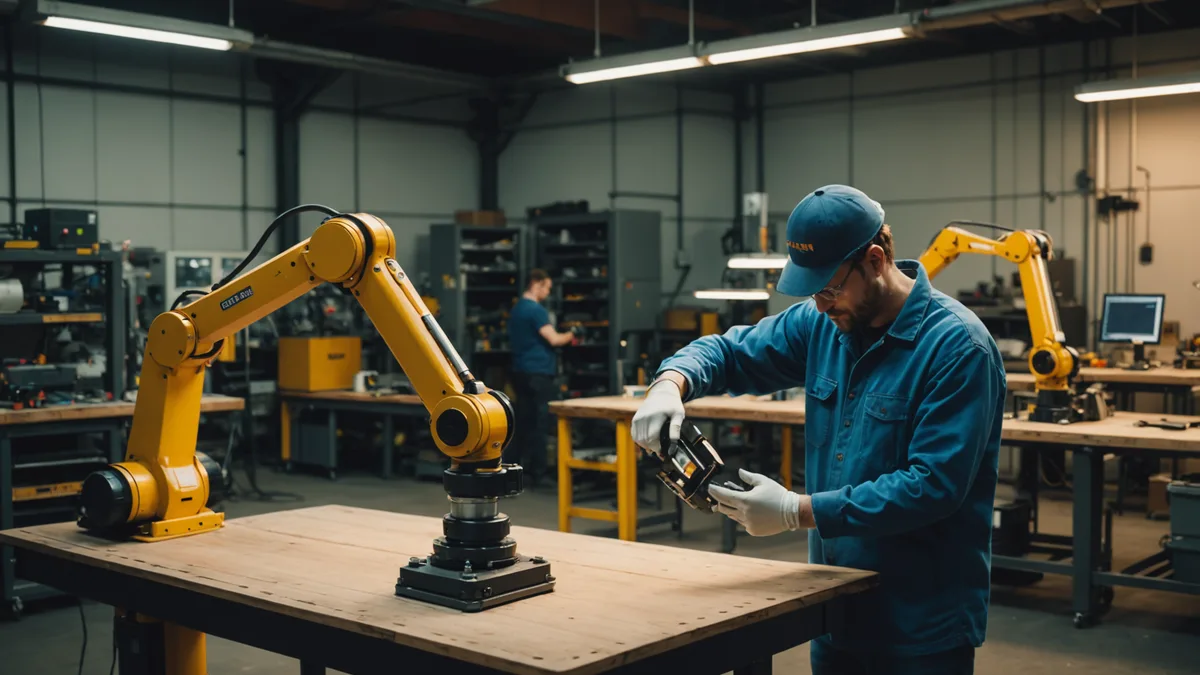
Human-Robot Collaboration in Practice
In industrial settings, "human-robot collaboration" describes many configurations, from cobots operating within arm's reach of operators to fully autonomous cells protected by safety interlocks. Discussion usually centers on the physical relationship: how near can people and robots work, what safety rating does the robot have, and how does force sensing prevent injury? Less attention goes to the knowledge relationship: who understands the task, and how does that knowledge enter the robot's control system?
Programming as Knowledge Translation
Under the conventional programming model, the operator performing the task holds its knowledge. She knows the motion sequence, grip points, fragile parts, and response when a part arrives at an unexpected angle. This is embodied skill rather than documented information.
To make the robot perform that task, an integrator visits the plant, observes the operator, asks questions, and converts those observations into a waypoint sequence or robot program. The conversion loses information. Major movements are captured, while the small adaptive adjustments the operator makes instinctively may be missed. The resulting program is a reasonable approximation, tested against the typical case, and deployed.
This approach is adequate when the task remains stable. The program covers the 95% case. The operator's adaptive handling of edge cases is either written as explicit conditionals or managed by stopping the robot and requesting human intervention. Knowledge is translated once, after which the robot runs the program indefinitely.
Where Translation Breaks Down
The translation model struggles when the task changes often. A new part variant may have slightly different geometry. A fixture may move for a larger batch. Inbound parts may come from another supplier with different tolerances. Every change starts another translation cycle: someone documents it, schedules the integrator, and the integrator creates an updated program.
The issue is not the integrator's competence, but cycle time. Translation takes days. When the line changes its product mix weekly or bi-weekly, translation can consume a significant share of the robot's operational calendar. While the new program is written, the robot is idle or operating with an outdated configuration.
Accuracy presents another concern. Every translation cycle creates another chance for an imperfect result. The integrator relies on observation and documentation rather than direct task experience. An operator who has performed the task for months has developed tacit knowledge that is genuinely difficult to encode in a waypoint sequence.
Teaching as Direct Knowledge Transfer
Teaching reverses the flow of knowledge. Rather than having an intermediary convert the operator's knowledge into code, the operator demonstrates the task directly to the robot. The system records the demonstration as sensor data, identifies the relevant motion pattern, and creates a policy for task execution.
The practical difference concerns configuration ownership. With programming, the integrator or automation engineer owns the configuration. With teaching, the person guiding the demonstration owns it. On a typical shop floor, that person is the line technician or experienced operator who already performs the task manually.
This has operational consequences. The robot's ability to run a task no longer depends on scheduling an external resource. The line team can update its task knowledge on its own schedule, using its own expertise, without submitting a service request. The interval between "the task changed" and "the robot reflects the change" shrinks from days to the length of a demonstration session.
What Teaching Does Not Replace
It is important to distinguish what teaching-based systems eliminate from what they do not. Physical setup still requires engineering: mounting the robot, configuring the safety zone, selecting and validating the end-of-arm tool, and completing initial commissioning checks. None of those activities disappears. Teaching removes the programming phase after commissioning and the reprogramming cycles after each task change.
Teaching does not replace the operator's judgment about task quality either. If the demonstrated motion creates parts with higher-than-acceptable defect rates, quality monitoring must provide that feedback. The system learns the motion, not the quality criterion. The line team must still verify that the policy generates acceptable output, particularly after task changes.
The Skill Distribution Shift
A less discussed effect of the teaching model is its impact on skill distribution across the line. Programming a robot requires robotics training or integrator access. Teaching one requires task knowledge and the ability to guide a physical demonstration, a skill already found among the workers performing that task.
This does not mean factories need fewer engineers. Control system maintenance, safety validation, and process optimization still require technical expertise. The narrower point is that task configuration, now dependent on specialist access, can be done by people with the most important qualification: knowing how to perform the task.
For manufacturing operations seeking greater flexibility without adding to engineering headcount, changing who can configure robot tasks affects staffing and training decisions. The question shifts from "how do we get more integrator time" to "how do we train our technicians to give good demonstrations."
What Good Collaboration Looks Like in Practice
The strongest human-robot collaboration configurations seen in early pilot contexts combine both models: engineers manage the mechanical and safety layer, while operators manage task knowledge. The engineer establishes the robot correctly and safely. The operator teaches the task. When the task changes, the operator updates the teaching. Because the operator handles the changeover, the engineer is not a bottleneck in that cycle.
This division of responsibility matches what each person knows. The engineer understands robot systems, safety standards, and mechanical integration. The operator understands the production task, the acceptable quality range, and the edge cases that matter on that specific line. Teaching-based systems provide one way to make that natural division of knowledge actionable.