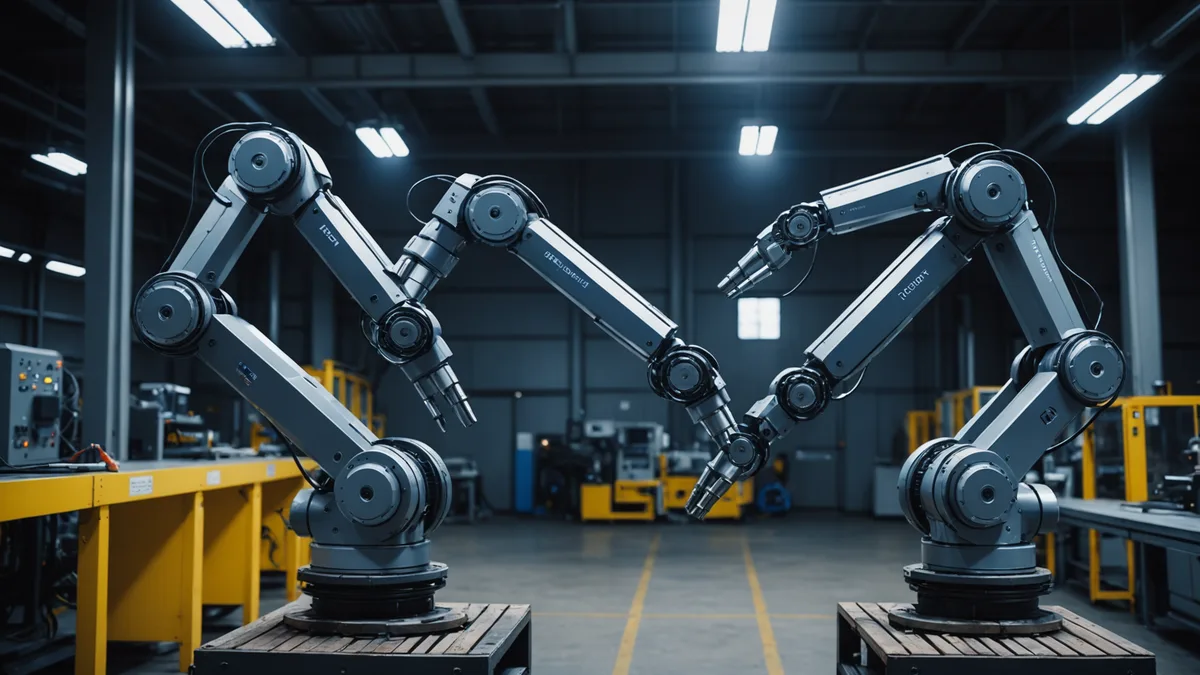
What Traditional Robot Programming Looks Like
Traditional robot programming follows a logic that is difficult to dispute on paper. You define exact joint angles, waypoints, and velocities, then the robot repeats them consistently. That predictability is the central value.
The practical difficulty is that predictable execution depends on a predictable environment. When part locations, fixture geometry, or task requirements shift, the program must shift as well. A programmer must make that change. In most industrial settings, that person is an external integrator who is neither on-site nor immediately available.
Traditional Programming in Practice
Teach-pendant programming remains the dominant method across industrial robot installations. An operator manually guides the robot to target positions, saves them as waypoints, and creates a program that follows them in sequence. For simple pick-and-place tasks with fixed part locations, it performs well. Programming takes days, the motion is precise, and once the system works, it keeps working.
Difficulty appears when conditions move. A 30mm shift in the incoming bin means the waypoints need revision. A product variant with a different gripper approach angle calls for a new path. A fixture redesigned for another assembly step may require rebuilding the entire motion program from scratch.
More advanced path languages, including RAPID (ABB), KRL (KUKA), and KAREL (FANUC), give integrators greater control of motion logic, conditional branches, and sensor integration. They do not remove the basic dependency: whenever the task changes, someone able to write the code must participate.
How Embodied AI Changes the Interface
For industrial robots, Embodied AI means building a motion policy from physical interaction data instead of code. In demonstration-based systems, a person physically guides the robot through the intended task, and the system derives a generalizable policy from that example.
This shifts robot configuration to a different person. A trained line technician can demonstrate the task without knowing inverse kinematics, waypoint coordinates, or motion language syntax. They understand how the part should be oriented, where the gripper should approach, and what the final placement should look like. The demonstration captures that operational knowledge directly.
The technical substance lies in how the system processes the demonstration. Pose estimation follows the robot's configuration throughout the task. Sensor streams record the relevant state variables. A policy learning step derives a generalized motion model that accommodates variation in part position and orientation within the trained distribution. The output is a deployable motion policy rather than a fixed path.
The Trade-offs Are Real
This does not mean embodied AI is strictly better than scripted programming. The trade-offs are genuine and deserve clear attention.
Scripted programs are fully inspectable. You can read the code, follow its logic, and know exactly what the robot will do in any specified state. When a failure occurs, the debugging route is direct. Embodied AI policies cannot be inspected in quite the same way. You can review performance statistics and observe the robot, but the internal representation is not readable by people.
Within their design envelope, scripted programs are also highly reliable. When the part always occupies the same position and the fixture never changes, a well-written script can exceed a demonstration-learned policy in repeatability and cycle time optimization. On stable lines, scripted motion can be tuned to microsecond precision.
Demonstration learning has the advantage when the design envelope keeps changing. The issue is not which method is absolutely technically superior. It is which method matches the operating reality of the particular line.
The Knowledge Transfer Problem
Demonstration-based learning offers a less-discussed benefit beyond setup time. With traditional programming, task knowledge resides in the integrator's head and in the code they create. If the integrator is unavailable, that knowledge cannot be accessed. Updating the code also demands the same expertise used to create it.
Demonstration-based systems pass knowledge directly from people who understand the task to the robot. The line technician guiding the robot is also the person who will run the line. They do not translate task knowledge for a programmer. They encode that knowledge themselves, creating a shorter and more direct route from task understanding to robot configuration.
Operational resilience is affected by this difference. A plant that can reconfigure a robot cell without an outside specialist depends less on external scheduling and faces less exposure to the cost spikes associated with emergency integrator visits.
What We Have Learned Building This
At Robai, we have spent the better part of two years addressing the specific challenge of making demonstration learning reliable in noisy industrial environments. The controlled lab version of these techniques performs well. The factory floor version adds constraints such as sensor noise, inconsistent lighting, fixture variation, and differences between operator demonstrations.
The policy training pipeline must accept demonstrations that are not perfectly identical. Operators guide the robot at different speeds and along slightly different approach trajectories. Part positions vary within bin tolerances, and fixtures have small geometric inconsistencies between units.
Much of our work focuses on making the system tolerate that variance without demanding perfectly controlled demonstrations. This is the gap between research demonstrations of imitation learning and a system that runs on a production floor.
The technical comparison between scripted and embodied methods depends on the task type. On stable, high-volume lines, scripted programming is likely the right choice, and we would not recommend changing a working system. On variable, task-switching lines where reprogramming is already a recurring burden, the alternative merits direct evaluation against real operating data.