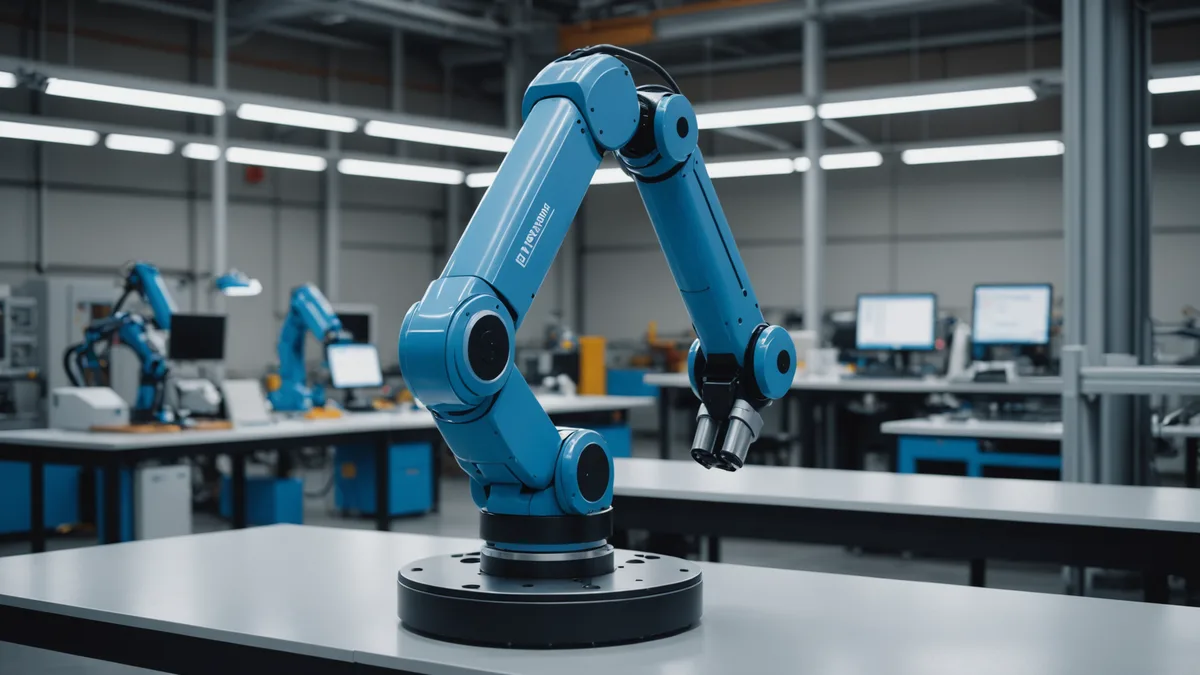
Cobots were marketed as an accessible starting point for manufacturers entering robot automation. The appeal was clear: no safety cages, quick deployment, and little programming. It was the industrial equivalent of plug-and-play. The hardware largely lived up to that promise. A cobot arm includes force limiting, vision-ready flange connections, and a teach pendant built around drag-and-drop waypoints. The underestimated effort lies between putting the robot on the floor and getting it to perform production tasks reliably.
Where the Time Goes
Installing the cobot hardware may take a day. The schedule usually stretches during integration. For a straightforward pick-and-place job at a contract electronics manufacturer, typical work includes installing end-of-arm tooling, tuning gripper parameters, writing or configuring waypoint sequences in the controller language, connecting I/O to the upstream conveyor or part-present sensors, testing paths with real parts at production speed, calibrating vision when a vision system is used, and documenting the setup for the maintenance team.
Every item seems contained on paper. In reality, the work moves back and forth among the robot integrator, the plant maintenance lead, the line supervisor who knows where parts actually leave the conveyor, and sometimes the original equipment manufacturer when existing line PLCs are involved. The cycle takes days rather than hours. For manufacturers we talk to, 10 to 20 business days from installation to a stable production run is common for a first deployment involving a new task type.
The Certified Integrator Requirement
Most cobot vendors advise manufacturers to use certified system integrators for deployments more involved than a simple demo. That guidance is sensible. Consistent performance through a production shift requires engineering, including motion planning that avoids singularities, payload and inertia calculations for the end-of-arm tool, TCP calibration, and collision-zone configuration for the collaborative workspace. A line technician should not have to improvise these steps.
The issue is not integrator competence. Integrators are shared resources, frequently booked weeks ahead, and their output is a static configuration file. If a part changes or a fixture moves, they must return. On lines with high product mix, production schedules then compete with integration calendars.
One recurring example involves a contract manufacturer using the same cobot on a three-month product cycle. Each quarter, the company schedules an integrator visit to retask the cobot for the next product variant. Labor and travel for that visit cost between $2,000 and $4,000. With three to four product changeovers per year, the expense compounds. The automation ROI that supported the cobot purchase did not account for quarterly reprogramming as a recurring line item.
Where the Cobot Promise Fails
The cobot category has addressed the hardware safety issue: force sensing, a collaborative workspace, and lightweight arms. Those capabilities are real and valuable. Cobots do not address the software configuration issue. The waypoint programming model that makes them approachable also leaves them brittle when the task changes.
This is not a complaint about any particular cobot vendor. For fixed manufacturing work, the waypoint model is a sensible choice: weld this seam, place this component in this fixture, or apply torque here. Such tasks have defined parameters and endpoints, so waypoints suit them.
The difficulty appears on mixed-production lines with several fixture types, multiple part families running during the same week, or seasonal product changes. In these settings, the cobot may spend a meaningful share of its operating life idle, waiting for reprogramming, or working at lower productivity with a configuration that does not quite match the current parts.
A Demonstration-Based Option
At Robai, we set out to ask whether demonstration could replace programming. The idea was not merely a simpler programming interface, but a learning loop: a technician guides the robot through the task once, the system extracts a motion policy from that demonstration, and the robot runs the policy in production.
This method does not eliminate every integration task. Mechanical setup, payload calibration, and workspace safety configuration still need engineering attention. It does remove the programming and reprogramming cycle. When a fixture changes, a technician demonstrates the new task, the system creates a new policy, and the cobot runs the revised task.
We do not claim that demonstration learning suits every cobot application. Tasks requiring sub-millimeter precision tolerances or complex force-torque profiles are more difficult. Long-horizon tasks with many sequential steps need more demonstrations to produce stable policies. For pick-and-place, assembly, and inspection work, which accounts for the majority of cobot deployments in small-batch manufacturing, the demonstration model shortens setup from days to hours.
What Changes on the Line
The practical shift concerns ownership of configuration knowledge. With an integrator model, that knowledge resides in the integrator's tooling and documentation, and access requires scheduling a service visit. With a demonstration model, it is captured from the person on the floor who already understands how the task works.
This does not suggest that every manufacturer should avoid integrators altogether. Their process engineering expertise, safety validation, and commissioning experience remain valuable for complex deployments. The narrower point concerns recurring task changes on variable production lines: demonstration-based learning lets the line team control its changeover schedule rather than coordinate with external resources.
For manufacturers assessing cobots today, the key question is not only "what does the robot cost?" It is also "what does retasking the robot cost, and how often will I need to do it?" The hardware purchase is the simple part. Ongoing integration overhead makes the total cost calculation more difficult. It is worth getting those figures right before signing a deployment contract.